
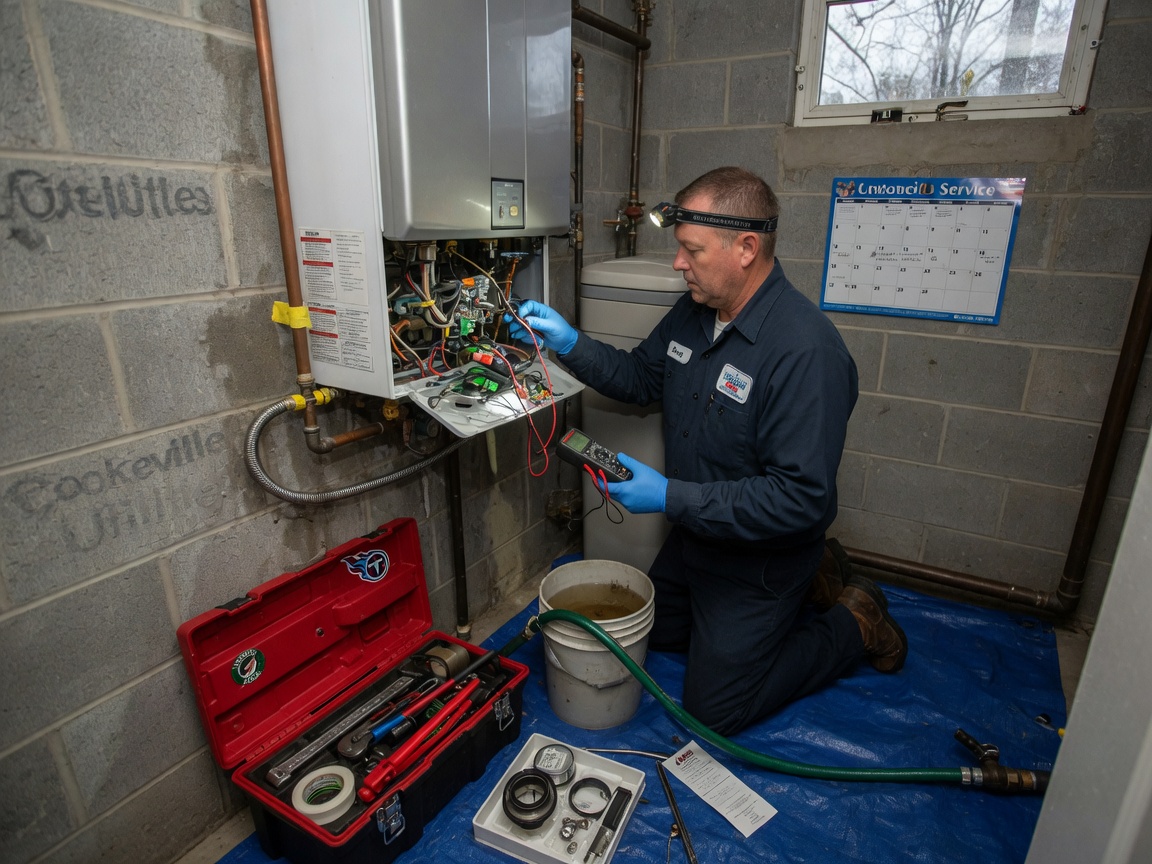
Tankless units in Cookeville homes often develop scale on the heat exchanger because Putnam County water carries moderate hardness that accelerates with the four distinct seasons. In older housing stock around Downtown Cookeville and West Cookeville, units installed in the early 2000s frequently show restricted flow after ten to twelve years when homeowners skip annual descaling. Technicians must isolate the unit, run a vinegar or citric solution through the system at the correct temperature, then verify flow sensor calibration before returning the unit to service. Skipping this step leads to repeated error codes during winter demand spikes when multiple fixtures run at once.
East Cookeville and Algood properties near Cane Creek Park sit on slightly higher terrain that experiences faster temperature drops in January and February. This creates condensation inside venting on tankless models not properly pitched, which corrodes the exhaust components over time. Repair calls here usually involve replacing the condensate trap and checking the venting slope against manufacturer clearances. Homes near Tennessee Tech University also see heavier use from rental properties where tenants adjust temperatures frequently, stressing the modulating gas valve and leading to ignition failures that require board-level diagnostics rather than simple resets.
Crossville, Lebanon, and Sparta residents sometimes bring units to Cookeville shops after attempting DIY flushes with incorrect solutions that damage gaskets. Local code requires proper isolation valves and expansion tanks on tankless retrofits in Putnam County, so technicians check these during every repair to prevent future leaks. Service in these neighborhoods focuses on restoring consistent hot water without short cycling, especially on units serving larger households where simultaneous showers and laundry exceed the original sizing.
Technician insight
In Cookeville, the thing that catches most people out with Tankless Water Heater Repair is the combination of hard water and older galvanized supply lines still found in many West Cookeville and Downtown homes built before the mid-1990s; the scale builds faster than on newer PEX runs and quickly fouls the flow sensor even after a single missed annual flush.
East Cookeville Tankless No-Heat Call
A homeowner in East Cookeville reported no hot water during a January cold snap. Inspection showed the flow sensor blocked by scale and the condensate line frozen from improper pitch. The sensor was replaced, the heat exchanger was descaled, and the vent was adjusted for proper drainage. Hot water returned consistently across all fixtures.
Tankless Water Heater Repair Services We Offer
✓Heat Exchanger Descaling
Removes mineral buildup that restricts flow and triggers error codes on tankless units common in older Putnam County homes.
✓Ignition and Flame Sensor Repair
Diagnoses and replaces faulty sensors or igniters that cause no-heat conditions during cold snaps in West Cookeville and Algood.
✓Flow Sensor Replacement
Restores accurate flow detection on units serving multiple fixtures in Downtown Cookeville rentals and East Cookeville homes.
✓Condensate Drain and Vent Cleaning
Clears blockages and corrects pitch on venting to stop corrosion in higher-elevation properties near Cane Creek Park.
✓Gas Valve and Modulating Repair
Calibrates or replaces the gas control assembly to eliminate short cycling during peak winter demand across Putnam County.
Tankless Water Heater Repair Cost in Cookeville, TN
| Service | Typical Range | What Affects It |
|---|---|---|
| Heat Exchanger Descaling | $250–$450 | Higher when heavy scale requires longer flush time or repeated solution cycles |
| Flow Sensor Replacement | $180–$320 | Varies by model availability and whether inlet screen is also clogged |
| Ignition System Repair | $200–$380 | Includes sensor or igniter; board replacement pushes cost higher |
| Condensate And Vent Service | $150–$275 | Lower for accessible units, higher when roof or crawlspace access is required |
Ranges are typical for Cookeville, TN and confirmed with an exact written quote before any work starts.
How it works
- 1
On-Site Diagnosis
Technician arrives within the service window, checks error codes, measures inlet and outlet temperatures, and inspects venting and water quality.
- 2
Isolation And Flush
Unit is isolated, descaled with approved solution, and flushed until flow returns to manufacturer specifications.
- 3
Component Testing
Sensors, igniter, and gas valve are tested under load; faulty parts are replaced with compatible components.
- 4
System Verification
Unit is returned to service, temperature stability is confirmed at multiple fixtures, and homeowner receives maintenance guidance.
Pricing
Upfront quotes given during business hours Mon–Sat 7am–10pm, Sun 8am–9pm; final price depends on parts needed and unit access.